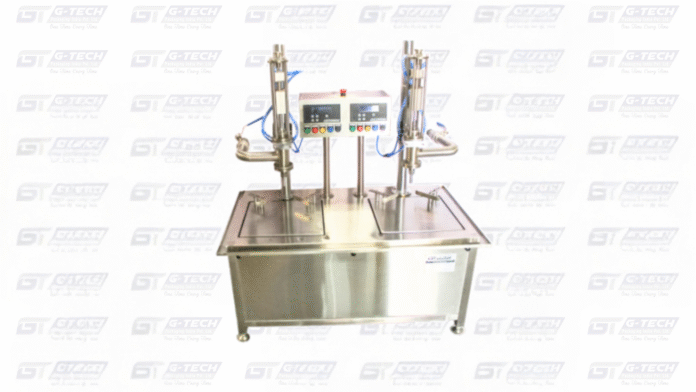

When it’s time to invest in a new liquid filling machine, one of the first technical decisions manufacturers face is the drive system: servo-driven or pneumatic. Both technologies are widely used across edible oil, lubricant, pharma, and chemical packaging lines — but they serve different priorities. Here’s how to think about the choice.
How They Work
Pneumatic piston filling machines use compressed air to drive the piston that pushes liquid into containers. They’re mechanically simple, well-proven, and have been the industry standard for decades.
Servo-driven filling machines use an electronically controlled motor to move the piston, with fill volume set and adjusted digitally through a PLC or HMI panel rather than mechanical stops.
Accuracy and Repeatability
This is where servo systems pull ahead. Because fill volume is controlled electronically rather than through air pressure — which can fluctuate with compressor load, temperature, and line pressure drops — servo filling delivers tighter, more repeatable fill accuracy, often within ±0.5% or better.
Pneumatic systems are accurate enough for many applications, but they’re more sensitive to viscosity changes and air supply consistency, which can cause gradual fill-volume drift over a shift.
Best fit for servo: Products with high per-unit value (pharma, cosmetics, specialty lubricants) where product giveaway or underfill has real financial or compliance consequences.
Changeover Flexibility
Switching fill volumes on a pneumatic machine typically means physically adjusting mechanical stroke limiters — a manual, tool-based process. On a servo machine, switching from a 500ml to a 1-liter fill is often a few taps on an HMI screen, with settings saved for instant recall next time.
Best fit for servo: Facilities running multiple SKUs or bottle sizes on the same line.
Cost Considerations
Pneumatic filling machines carry a lower upfront cost and are simpler to maintain — there are fewer electronic components to service, and most maintenance technicians are already familiar with pneumatic systems.
Servo machines cost more initially but reduce product giveaway over time (since overfilling to “play it safe” becomes unnecessary), and they typically need less manual recalibration.
Best fit for pneumatic: Single-SKU or low-SKU-count operations where fill precision requirements are moderate and budget efficiency matters most.
Viscosity Range
Highly viscous liquids — like thick lubricants or gels — put more strain on pneumatic systems, since consistent piston speed is harder to maintain against variable resistance. Servo motors maintain consistent piston speed and pressure regardless of viscosity, making them more reliable for viscous or non-uniform liquids.
Which Should You Choose?
| Factor | Pneumatic | Servo |
|---|---|---|
| Upfront cost | Lower | Higher |
| Fill accuracy | Good | Excellent |
| Changeover speed | Manual, slower | Digital, fast |
| Ideal for multi-SKU lines | Limited | Strong |
| High-viscosity liquids | Moderate | Strong |
| Maintenance complexity | Simple | Moderate |
There’s no universally “better” option — the right choice depends on your product range, fill-accuracy requirements, and how often you switch SKUs. Many growing manufacturers start with pneumatic systems and transition to servo-driven lines as their SKU count and volume grow.
At G-Tech Packaging, we manufacture both pneumatic piston fillers and fully automatic servo filling machines, and our team can help you match the right drive technology to your actual production needs rather than a one-size-fits-all recommendation.
Not sure which system fits your line? Talk to our engineering team for a recommendation based on your product and output requirements.