If you pack liquor, cough syrup, juice, edible oil or any product sold in a glass or PET bottle with an aluminium cap, you have probably seen ROPP closures. ROPP stands for Roll-On Pilfer-Proof. Unlike a ready-made screw cap, an ROPP cap starts as a plain aluminium shell with no threads. The threads and the tamper-evident band are formed directly on the bottle neck by a ROPP capping machine.
This guide explains how a ROPP capping machine works, which machine type suits your output, what to check before buying, and how to fix the most common capping faults on the shop floor.
What Is a ROPP Capping Machine?
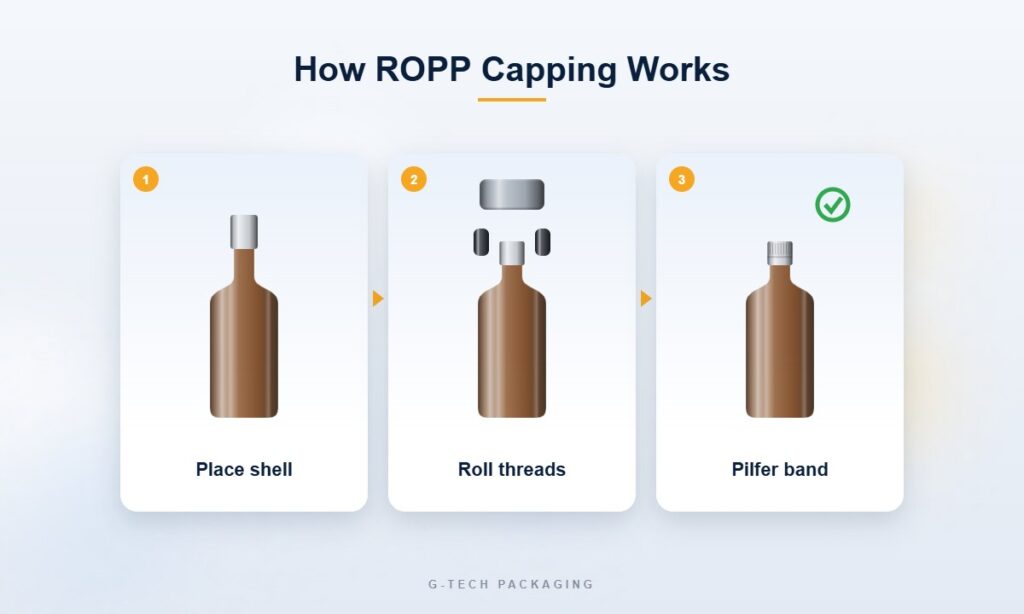
A ROPP capping machine places a plain aluminium shell on the bottle neck and then uses a capping head with small rollers to shape the metal around the neck. One roller presses the soft aluminium into the glass or plastic threads of the bottle, so the cap takes the exact shape of those threads. A second roller tucks the lower edge of the shell under the neck bead. This lower ring becomes the pilfer-proof band, which breaks when the consumer opens the bottle for the first time.
Because the cap is formed on the bottle itself, a correctly set ROPP closure gives a tight, uniform seal and a clear sign if anyone has tampered with the product. That is why it is widely used where product safety and brand protection matter.
How the ROPP Capping Process Works
- Cap feeding: shells are oriented in a hopper or bowl feeder and delivered down a chute to the bottle neck.
- Top pressure: the capping head comes down and holds the shell firmly with a set top load, pressing the liner against the bottle mouth.
- Thread rolling: the thread roller moves around the shell and forms threads that follow the bottle’s own thread profile.
- Pilfer band rolling: the pilfer roller tucks the bottom edge of the shell under the neck bead to form the tamper-evident ring.
- Release: the head lifts and the capped bottle moves on to the next station, such as induction sealing, labeling or cartoning.
Types of ROPP Capping Machines
The right machine depends mainly on your speed requirement, the number of bottle sizes you run and how much floor space you have. The table below gives a simple comparison.
| Machine type | Suitable for | Key points | ||
|---|---|---|---|---|
| Semi-automatic single head | Small batches, trials, start-ups | Operator places bottle and shell | low investment | output depends on the operator |
| Automatic linear (single or multi-head) | Small to medium plants | Fits inline after a filling machine | easy to understand and maintain | |
| Automatic rotary multi-head | High-speed lines | Several heads work in parallel | higher output | needs careful change parts for each bottle size |
Many Indian plants place the ROPP capper directly after their liquid filling machine, so the bottle is closed within seconds of filling. Browse our range of capping machines to see which configuration fits your line.
What to Check Before Buying a ROPP Capper
- Bottle and cap samples: always share real bottles and caps with the supplier. Neck finish, thread profile and cap height must match the head tooling.
- Range of sizes: list every bottle and cap size you plan to run, now and in the near future, so that change parts can be planned.
- Output needed: base the speed on your filler’s output, not on a round number. The capper should be slightly faster than the filler so it never becomes the bottleneck.
- Adjustability: top load, roller pressure and roller height should be easy to set and to repeat after a changeover.
- Cap feeding: check how the shells are fed and how the machine handles a missing cap or a fallen bottle.
- Hygiene and build: for pharma and food lines, ask about contact-part materials, guarding and ease of cleaning.
- Service support: ask about spare rollers, springs and the availability of technicians for setup.
Common ROPP Capping Problems and Their Usual Causes
Most ROPP faults come from settings or worn parts rather than from the machine design. Here are the issues operators see most often.
- Loose caps that turn by hand: often caused by low top load or thread rollers not pressing deep enough.
- Torn or cracked caps: usually too much roller pressure, or shells made from aluminium that is too hard.
- Pilfer band not breaking on opening: the pilfer roller may be set too high or with too little pressure, so the band is not tucked under the bead properly.
- Wrinkled cap tops: can point to uneven top pressure or a liner that does not sit flat.
- Scratches on caps: check rollers for burrs or wear, and keep the head clean.
A simple habit helps a lot: after every change of bottle or cap lot, run a few bottles, open them by hand, and check thread form, band breakage and leak-tightness before starting full production. Our article on cap torque problems explains how to make such checks part of your daily routine.
Maintenance Tips for Long Roller Life
- Clean aluminium dust from heads and rollers at the end of each shift.
- Inspect rollers regularly for flat spots, grooves or burrs, and replace them in sets.
- Check springs that control roller pressure; a tired spring changes the cap quality slowly over weeks.
- Keep a written record of the settings that work for each bottle and cap combination.
- Train at least two operators on setting the head, so production does not depend on one person.
ROPP is common in pharmaceutical syrup lines and in edible oil bottling, where tamper evidence builds consumer trust.
Frequently Asked Questions
What does ROPP mean?
ROPP means Roll-On Pilfer-Proof. The cap starts as a plain aluminium shell, and the threads and tamper-evident band are rolled onto the bottle neck by the capping machine.
Can one ROPP capping machine handle different bottle sizes?
Usually yes, with suitable change parts and height adjustment. The exact range depends on the machine design, so share all your bottle and cap sizes with the supplier before ordering.
Do I still need induction sealing with ROPP caps?
It depends on your product and market. Some manufacturers add an induction-sealed liner under the ROPP cap for an extra leak barrier and tamper evidence. Discuss your product and distribution conditions with your packaging supplier.
Talk to G-Tech Packaging About Your ROPP Capping Line
G-Tech Packaging India Pvt. Ltd., Ahmedabad, designs and builds automatic liquid filling, capping, induction sealing, labeling, leak testing, shrink tunnel and box sealing machines for Indian manufacturers. Share your product, container samples and target output with our team, and we will suggest a practical machine or full line for your plant.
Contact us here or write to sales@gtechpackaging.in to discuss your requirement.