
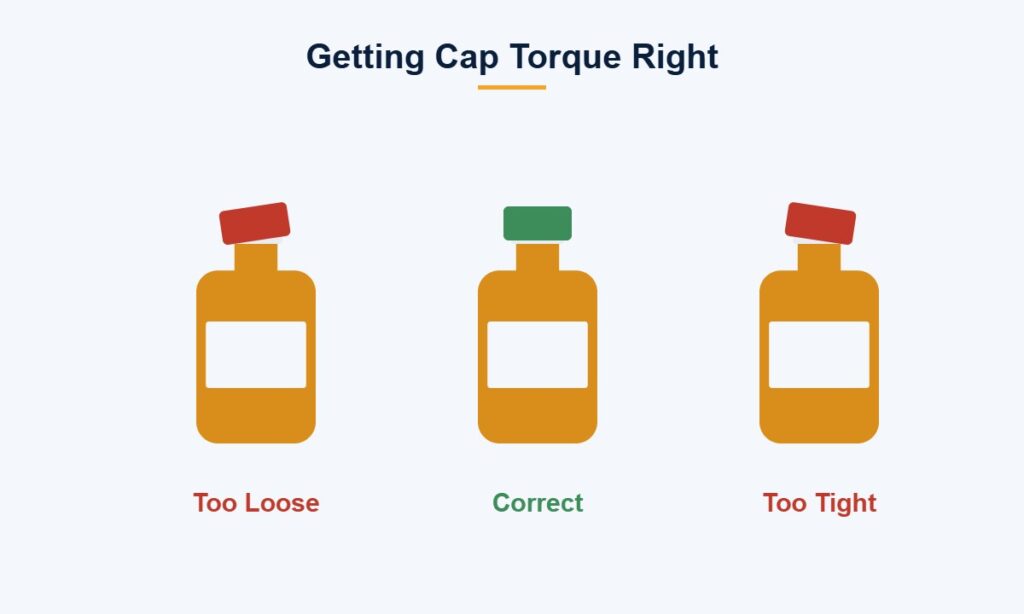
A bottle can be filled perfectly, labeled beautifully and still fail in the market because of its cap. Loose caps leak during transport. Over-tightened caps frustrate customers who cannot open them, and can crack the cap or strip the threads. Crooked caps look careless on the shelf. All of these come down to one thing: cap torque, the twisting force used to tighten the cap.
This guide explains the most common cap torque problems seen on Indian filling lines, what usually causes them and how to fix them, whether you pack edible oil, lubricants, pesticides or personal care products.
What Is Cap Torque and Why Does It Matter?
Torque is the rotational force applied when the cap is screwed on. Too little, and the cap can back off with vibration, letting product seep out. Too much, and the cap or neck can deform, the liner gets crushed and the customer struggles to open it. The right torque depends on the cap size, cap material, bottle neck and liner, so it should be agreed with your cap and bottle suppliers.
A correct torque gives you:
- Leak-free bottles during long road transport
- Caps that customers can open without tools
- Proper compression of liners and induction seal wads
- Consistent appearance on the shelf
Common Cap Torque Problems and Their Causes
| Problem | Likely causes | What to check |
|---|---|---|
| Loose caps | Low torque setting, worn clutch or chuck inserts, slipping | Torque setting, chuck grip, clutch condition |
| Over-tight caps | Torque set too high, wrong chuck, heat-softened caps | Setting, cap material, line temperature |
| Crooked or cross-threaded caps | Cap not seated before tightening, bottle not held firmly | Cap placement, bottle gripping, alignment |
| Inconsistent torque | Varying air pressure, worn parts, mixed cap batches | Air supply, wear parts, incoming caps |
| Scratched or marked caps | Hard or worn chuck inserts | Chuck insert material and wear |
Step-by-Step Fixes
1. Confirm the Target Torque
Start by agreeing on a target range with your cap supplier. Without a defined target, operators adjust by feel, and every shift ends up different.
2. Check How the Bottle Is Held
If the bottle spins or tilts while the cap is tightened, torque cannot be consistent. Check the bottle grippers or belts, and set guide rails correctly for the bottle size. Oval and flat bottles need especially firm holding.
3. Inspect the Chuck and Clutch
Rubber or polymer inserts inside the chuck wear with use. Worn inserts slip, giving loose caps, or grip unevenly. Magnetic or mechanical clutches also need periodic checking. Add these parts to your preventive maintenance routine.
4. Stabilise the Air Supply
Pneumatic cappers depend on steady air pressure. A compressor that cannot keep up, or leaks in air lines, causes torque to vary through the day. Use a pressure regulator and gauge at the machine.
5. Watch Cap and Bottle Quality
Different cap batches can have slightly different dimensions or thread finish. If problems start suddenly after a new cap delivery, check incoming caps before adjusting the machine.
Measure, Don’t Guess
A simple cap torque tester lets you check sample bottles at the start of each shift and after every changeover. Record readings in a log. Over time you will see trends, such as torque slowly dropping as chuck inserts wear, and can act before customers complain. Pairing torque checks with a leak testing machine gives extra confidence for products like lubricants and pesticides.
Choosing the Right Capping Machine
Modern capping machines offer adjustable torque control so the same machine can handle different caps. Servo-driven cappers allow precise, repeatable settings from a control screen, while pneumatic cappers are simple and widely used. If you are choosing a new capper, our guide on choosing the right capping machine for your bottle is a useful starting point.
Frequently Asked Questions
Why do caps loosen after a few days?
Common reasons are low application torque, liners relaxing over time, temperature changes and vibration in transport. Re-check torque some time after capping, not only immediately.
Can over-tightening damage induction seals?
Excessive torque can crush or distort the seal wad, which may affect sealing quality. Correct, consistent torque helps induction sealing work properly.
How often should I check cap torque?
Check at the start of each shift, after every changeover and whenever you receive a new batch of caps.
Talk to G-Tech Packaging India, Ahmedabad
Struggling with loose or uneven caps? G-Tech Packaging India, Ahmedabad builds capping machines with adjustable torque control and can help you diagnose problems on your line. Share your product, container sizes and target output with our team, and we will suggest a practical machine set-up for your plant. Contact G-Tech Packaging India or email us at sales@gtechpackaging.in.