
Every bottle that leaves your plant carries a small line of print that most customers never notice: the batch number, the date of manufacture or packing, and often an expiry or best-before date. For a factory owner, this tiny code is anything but small. It is how you trace a complaint back to one shift, how you prove compliance during an inspection, and how a distributor decides which stock to sell first.
Yet many Indian plants still add codes by hand with rubber stamps, or bolt a coder onto the line as an afterthought. The result is smudged dates, missing codes and a bottleneck at the end of an otherwise automatic line. This guide explains where a batch coding machine for bottles fits, what types are available and how to get clean, readable codes every time.
Why Batch Codes Matter for Indian Manufacturers
Batch coding is not only good practice; for most packaged goods it is required. Food businesses follow FSSAI labelling rules, which ask for details such as the lot or batch number and the date of manufacture or packing on prepackaged food. Packaged commodities in general fall under the Legal Metrology (Packaged Commodities) Rules, and medicines carry batch, manufacturing and expiry details under drug regulations. The exact requirements depend on your product, so always confirm them with your compliance consultant.
Beyond the law, a clear code protects your brand in practical ways:
- Traceability: if a customer reports a problem, you can find the exact batch, date and line that produced it.
- Targeted recalls: you pull back one batch instead of every bottle in the market.
- Stock rotation: distributors and retailers can follow first-expiry, first-out.
- Trust: a crisp, straight code looks professional; a smudged stamp looks careless.
Where the Coder Sits on a Filling Line
On a typical automatic line, bottles move from the filling machine to the capping machine, then to induction sealing, labeling and finally cartoning. The coder can be placed at different points depending on where you want the code to appear.
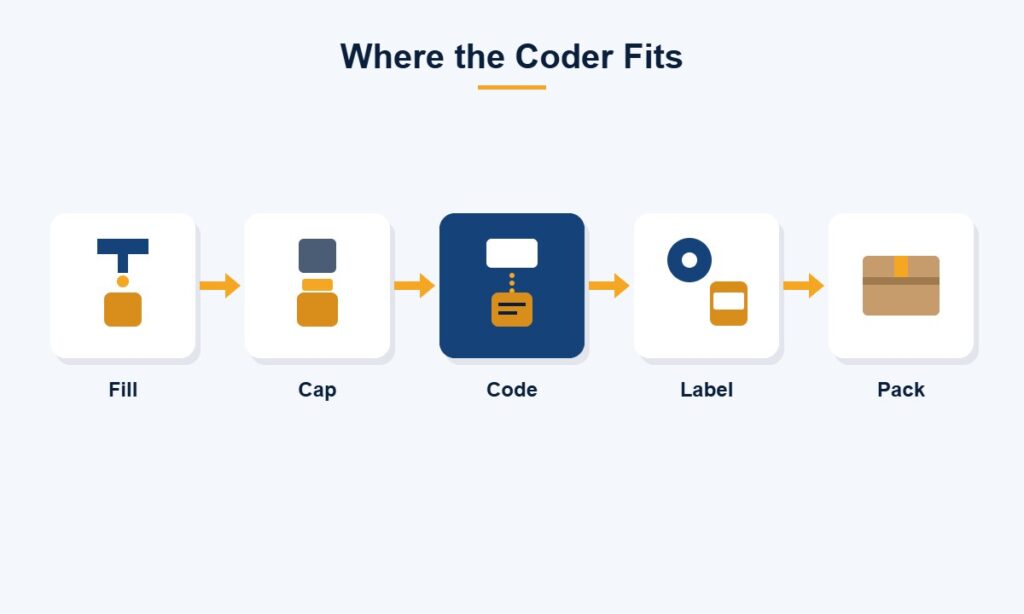
- On the cap or shoulder: the coder is mounted after the capping machine, printing on the cap top or bottle shoulder as bottles pass.
- On the label: the coder sits on or just after the sticker labeling machine, printing into a blank space left on the label.
- On the carton: a second coder near the box sealing machine prints batch details on outer cartons for warehouse handling.
The key rule is simple: the coder must see a stable, evenly spaced container. If bottles wobble, touch each other or change speed in front of the print head, the code will be distorted. That is why coders work best on a well-adjusted conveyor with guide rails set to the container size.
Common Types of Batch Coding Machines
There are several coding technologies on the market. Each suits a different surface, speed and budget. G-Tech Packaging focuses on filling, capping, sealing and labeling machines, and our lines are designed so that a coder of your choice can be integrated smoothly.
| Coder type | How it works | Typical use |
|---|---|---|
| Contact (hot stamp / roll coder) | Heated ribbon or inked roller presses the code | Labels, pouches, flat surfaces at moderate speed |
| Continuous inkjet (CIJ) | Fine ink droplets sprayed without contact | Caps, curved bottles, tins, high-speed lines |
| Thermal inkjet (TIJ) | Cartridge-based printing, sharp text | Labels, cartons, pharma and cosmetic packs |
| Laser coder | Marks the surface without ink | Plastic, coated labels, where no consumables are wanted |
There is no single best choice. A small edible oil unit labeling a few thousand bottles a day may be happy with a contact coder on the labeler, while a lubricant plant printing on curved HDPE bottles at higher speed may prefer an inkjet. Ask your coder supplier for sample prints on your actual bottles and labels before deciding.
Tips for Clean, Readable Codes
- Keep the print surface clean and dry; oil films and condensation are the most common cause of smudging on edible oil and ghee bottles.
- Fix the distance between print head and container; a few millimetres of drift changes print quality.
- Use a product sensor so the coder fires only when a bottle is present.
- Leave a clear, uncoated window on the label artwork for the code.
- Check code legibility at the start of each shift and after every changeover.
- Keep a daily log of batch numbers used, so codes match your production records.
If your line already suffers from frequent stops, coding problems will only add to them. Our guide on FSSAI labelling and your packaging line explains how labeling and coding work together for food brands.
Planning Coding for Your Industry
Edible oil, ghee and food and beverage brands usually need dates and batch numbers on each bottle. Pharmaceutical packs need batch, manufacturing and expiry details with a strong focus on legibility. Lubricant and pesticide makers often print on caps or containers that face oil, chemicals and rough handling, so durable inks or laser marking can make sense. Discuss your product and storage conditions with both your machine supplier and coder supplier so the code lasts as long as the product.
Frequently Asked Questions
Can a batch coder be added to an existing filling line?
Yes, in most cases. The coder is mounted on a bracket beside the conveyor or labeler. What matters is a stable conveyor, proper guide rails and a product sensor. Older lines may need conveyor or guide adjustments first.
Should I print on the cap, the label or the bottle?
It depends on your product and regulations. Label printing is neat and easy to read; cap printing keeps label artwork clean; direct bottle printing suits some plastic containers. Try sample prints on your actual packs.
Does coding slow down an automatic line?
A correctly chosen coder should match your line speed. Slowdowns usually come from choosing a coder too slow for your output, or from poor container spacing in front of the print head.
Talk to G-Tech Packaging India, Ahmedabad
Planning a new bottle line or upgrading an existing one? G-Tech Packaging India, Ahmedabad designs filling, capping, sealing and labeling lines that leave the right space and conveyor stability for reliable batch coding. Share your product, container sizes and target output with our team, and we will suggest a practical machine set-up for your plant. Contact G-Tech Packaging India or email us at sales@gtechpackaging.in.