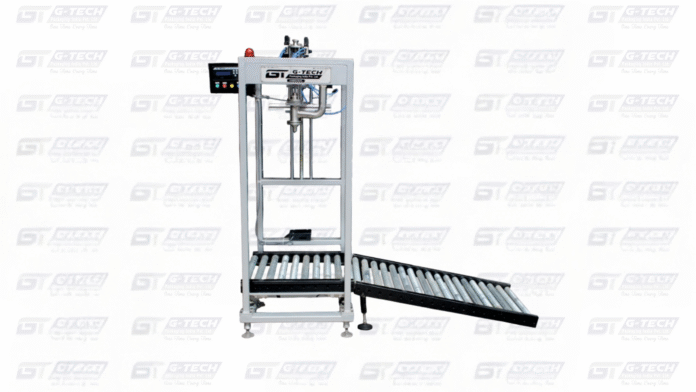
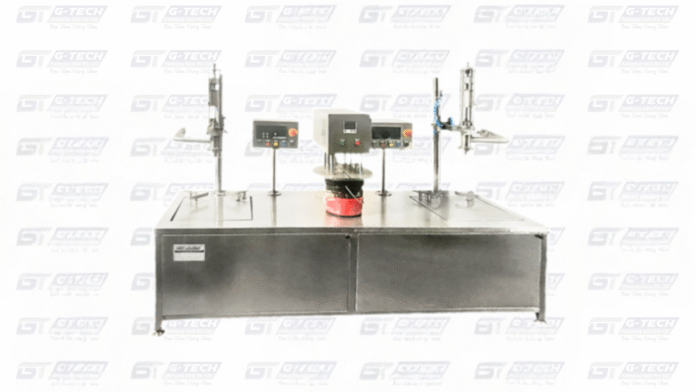
When a plant moves to automatic filling, one of the first decisions is the machine architecture: a linear (inline) filler or a rotary filler. Both can fill accurately, but they behave very differently on the shop floor. The right choice depends on your output target, the number of container sizes you run, available floor space and budget.
This article explains how each type works and compares them on the points that matter most to Indian manufacturers.
How a Linear Filling Machine Works
In a linear filler, containers travel in a straight line on a conveyor. A set of containers is stopped under a row of nozzles by gates or stoppers, the nozzles fill them together, then the filled set moves on and the next set comes in. This is an intermittent, stop-fill-move action. Output rises with the number of nozzles, so many linear machines are offered with several heads.
How a Rotary Filling Machine Works
In a rotary filler, containers enter through an infeed starwheel onto a rotating turret. Each container sits under its own filling valve and is filled while the turret keeps turning. By the time it reaches the discharge starwheel, the fill is complete. Because motion is continuous, rotary machines are suited to high-speed lines. Many are built as rotary monoblock filling and capping machines, where filling and capping happen on one frame.
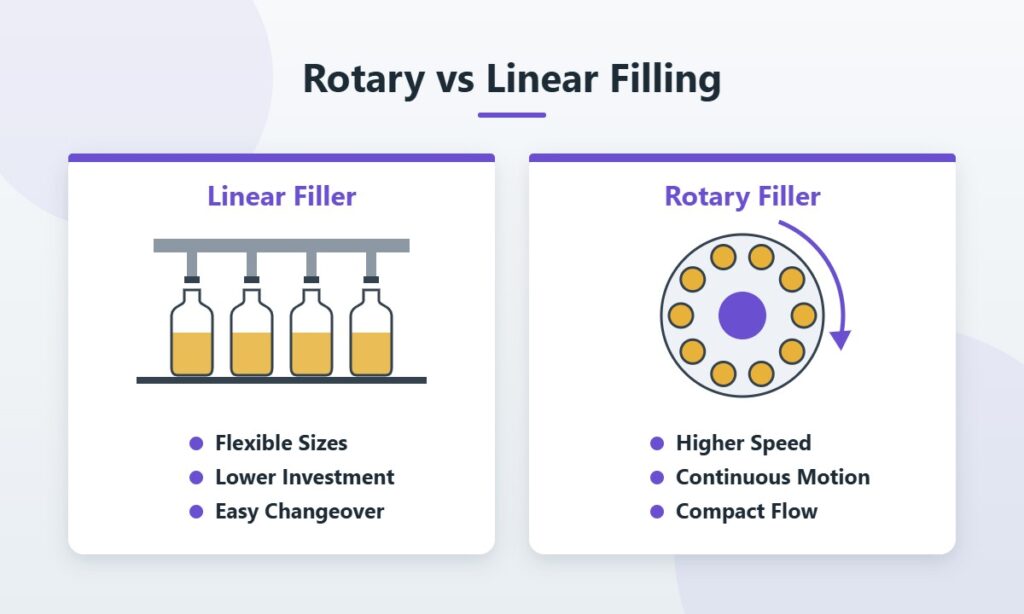
Rotary vs Linear: Side-by-Side Comparison
| Factor | Linear filler | Rotary filler |
|---|---|---|
| Motion | Intermittent (stop, fill, move) | Continuous rotation |
| Typical speed range | Low to medium, rises with more heads | Medium to high |
| Changeover | Usually simpler: rails and settings | Needs change parts such as starwheels |
| Container range | Very flexible, incl. odd shapes and large jars | Best for stable, uniform containers |
| Floor space | Longer footprint | Compact for its output |
| Initial investment | Generally lower | Generally higher |
| Expansion | Can often add heads later | Output fixed by turret size |
When a Linear Filler Makes More Sense
- You run many container sizes and shapes and change over often.
- Your output target is moderate and you want a lower starting investment.
- You fill larger containers such as jars, cans or tins, which are common in agro-chemical and lubricant packing.
- You want a machine your team can learn and adjust quickly.
- You plan to grow step by step, adding heads or a second machine later.
When a Rotary Filler Makes More Sense
- You need high, steady output on a small number of container sizes.
- Floor space is limited and you want filling and capping on one frame.
- Your containers are round and stable enough for starwheel handling.
- You are building a dedicated high-volume line for one or two products.
Questions to Ask Before You Decide
Start with your real numbers rather than the machine. Write down the containers you run today and plan to run in the next few years, the bottles per minute you need at peak season, and how often you change over. Then consider the rest of the line: a fast filler is wasted if capping, sealing and labeling cannot keep up. Matching the filler with suitable capping machines and downstream equipment keeps the whole line balanced.
Accuracy is rarely the deciding factor between the two types. Both can fill precisely when the filling principle (volumetric, weight or level) is chosen correctly for the product. The bigger differences are speed, flexibility and cost.
Line layout matters too. If you are still planning the floor, our guide on planning a bottle filling line layout can help. You can also browse G-Tech’s full range of liquid filling machines.
Look at the Cost of Ownership, Not Just the Price
The purchase price is only part of the cost. Think about how much production time is lost to changeovers each week, the cost of change parts for every new container, the skill level your operators need, and how easily spare parts and service can be arranged. A linear machine with quick changeovers may produce more saleable bottles per week in a multi-product plant than a faster rotary machine that spends hours on changeovers.
On the other hand, a plant that runs one or two container sizes all day may recover the higher investment of a rotary machine through higher output and lower labour per bottle.
Can a Plant Use Both?
Many growing manufacturers do. A common pattern is a rotary monoblock line dedicated to the best-selling container, with a flexible linear filler handling smaller batches, trial products and larger pack sizes. This keeps the high-volume line running without frequent changeovers while still giving the business room to launch new packs.
Frequently Asked Questions
Is a rotary filling machine more accurate than a linear one?
Not necessarily. Accuracy depends on the filling principle and setup. Rotary machines mainly offer higher continuous speed, while linear machines offer flexibility.
Which is better for a small or medium plant?
Many small and medium plants start with a linear filler because of lower investment and easier changeovers, then add a rotary line when one product reaches high volumes.
Can a rotary filler handle different bottle sizes?
Yes, usually with a set of change parts such as starwheels and guides for each container. Changeover takes longer than on most linear machines.
Talk to G-Tech Packaging India
Not sure which filler suits your output? G-Tech Packaging India Pvt. Ltd., Ahmedabad, designs and builds liquid filling, capping, induction sealing, labeling, leak testing, shrink tunnel and box sealing machines for Indian manufacturers. Share your container, product and output target with our team through the Contact Us page or email sales@gtechpackaging.in, and we will suggest a practical machine setup for your line.