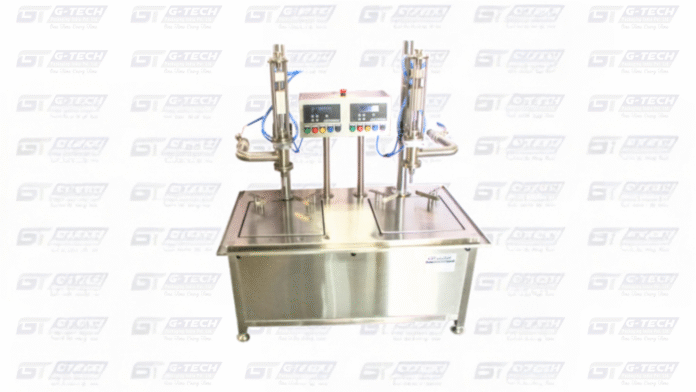
If you fill syrups, oral liquids, antiseptic solutions or other regulated products, buying a filling machine is only half the job. Before the machine can run commercial batches, your quality team will want proof that it was installed correctly, works as intended and consistently produces acceptable packs. That proof is built through equipment qualification, usually described as IQ, OQ and PQ.
This guide explains filling machine validation IQ OQ PQ in plain terms for factory owners and production managers. It is not a substitute for your own quality system or regulatory advice, but it will help you plan the work and talk clearly with your machine supplier and QA team.
Where IQ, OQ and PQ Fit in the Machine Lifecycle
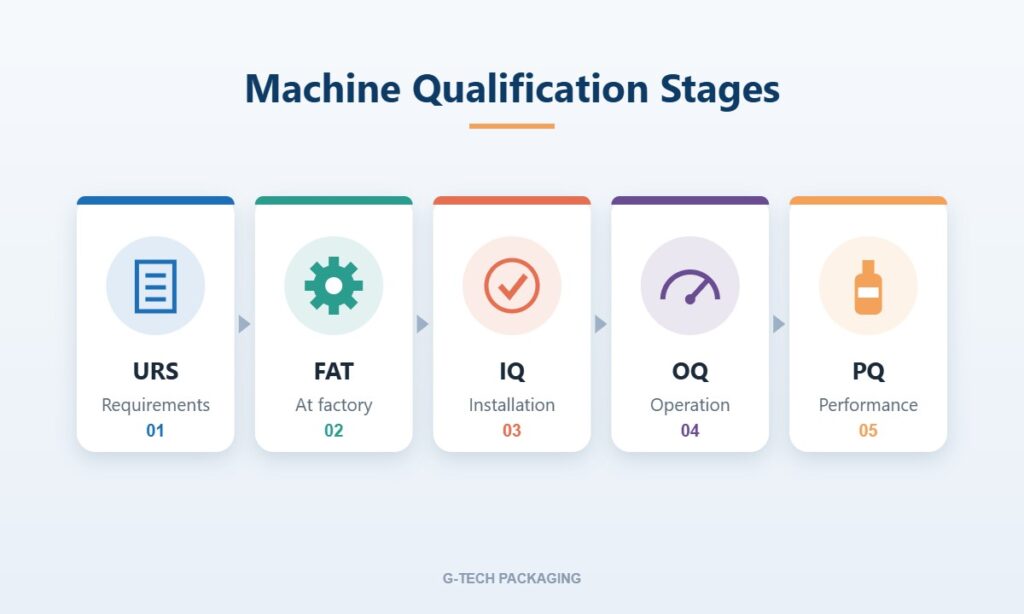
Qualification is the final part of a longer chain. Before a regulated filling machine is ordered, most companies prepare a User Requirement Specification (URS) that describes what the machine must do: container range, fill volumes, accuracy expectations, speed, materials in contact with product, cleaning needs and documentation. The supplier responds with a design, and the buyer often reviews it in a design qualification step.
Many buyers then carry out a Factory Acceptance Test at the supplier’s works before dispatch. We have covered this in detail in our article on the factory acceptance test for packaging machines. IQ, OQ and PQ follow once the machine reaches your plant.
Installation Qualification (IQ)
IQ confirms that the machine you received is the machine you ordered and that it has been installed correctly in your facility. Typical IQ checks for a liquid filling machine include:
- Machine model, serial number and major components match the approved specification
- Contact parts are of the specified material, with material certificates where required
- Utilities are connected as specified: electrical supply, earthing, compressed air quality and pressure
- Instruments and sensors that need calibration have valid calibration records
- Manuals, drawings, electrical diagrams, spare parts lists and software version are available and recorded
- The machine is level, safely guarded and placed as per the approved layout
Operational Qualification (OQ)
OQ shows that the machine operates as intended across its specified operating range. Here the focus moves from what the machine is to what it does. For a filling and capping line, OQ commonly covers:
- Each function working correctly: conveyor, bottle stoppers, nozzle movement, pumps or pistons, capping heads
- Fill volume setting at minimum and maximum of the range you will use
- Safety interlocks, emergency stops and guard door switches
- Alarms such as no-bottle no-fill, low product level and cap absence
- HMI screens, recipe storage, user access levels and, where applicable, audit trail functions
- Speed settings across the planned operating range
OQ is usually done with water or a placebo liquid. The protocol defines each test, the method, the acceptance criteria and who signs it off.
Performance Qualification (PQ)
PQ demonstrates that the machine consistently performs well under real production conditions, with your actual product, containers, closures and operators. It is normally run over several batches or production runs so that consistency, not a single good result, is proven.
PQ for a filling line often looks at fill volume or weight variation across samples, cap tightness, seal integrity, label placement and overall reject rate. The acceptance criteria come from your product specifications and quality requirements.
IQ vs OQ vs PQ at a Glance
| Stage | Key question | Typical evidence |
|---|---|---|
| IQ | Was the right machine installed correctly? | Specification checks, certificates, utility and calibration records |
| OQ | Does every function work across its range? | Function tests, alarm and interlock tests, range tests with water or placebo |
| PQ | Does it consistently make good packs in real production? | Batch data on fill accuracy, sealing, capping and rejects |
How to Plan Validation With Your Supplier
Validation goes much faster when it is planned at the time of purchase instead of after installation. A few practical steps help:
- Share your URS and documentation expectations with the supplier before the order is final
- Agree who will draft the IQ and OQ protocols and who will execute and sign them
- Ask for the documentation package you need, such as material certificates, drawings and manuals, as part of the order
- Plan utilities and room readiness so IQ is not delayed waiting for air or power
- Schedule PQ batches with production and QA once OQ is closed
For pharma lines, machine design also matters for validation: smooth contact parts, easy cleaning, accurate dosing and reliable sealing make the qualification simpler. You can see our approach on the pharmaceutical packaging page, along with machines such as liquid filling machines and online induction sealing machines that are often part of a validated line.
When Do You Need to Re-Qualify?
Qualification is not a one-time event. Your quality system will define when re-qualification or a documented assessment is needed. Common triggers include relocating the machine, major repairs, software changes, adding new container sizes or products, and periodic reviews.
Frequently Asked Questions
Is IQ OQ PQ mandatory for every filling machine?
It is expected for equipment used in regulated manufacturing such as pharmaceuticals, where your quality system and the applicable GMP requirements govern it. Food and chemical plants may follow a simpler acceptance process. Your QA team should decide the level needed.
Who writes the IQ and OQ protocols?
It varies. Some buyers write their own protocols, others ask the supplier to provide draft protocols that the buyer reviews and approves. Agree this before ordering so the responsibilities are clear.
Can OQ be done with water instead of product?
Yes, OQ is commonly carried out with water or a placebo to test machine functions. PQ is then done with the actual product, containers and closures under normal production conditions.
Talk to G-Tech Packaging About Your Line
G-Tech Packaging India Pvt. Ltd., Ahmedabad, designs and builds automatic filling, capping, induction sealing, labeling, leak testing, shrink tunnel and box sealing machines for Indian manufacturers. If you are planning a validated liquid filling line for pharmaceutical or other regulated products, share your container sizes, product details and target output with our team and we will suggest a practical machine configuration. Contact us here or write to sales@gtechpackaging.in.