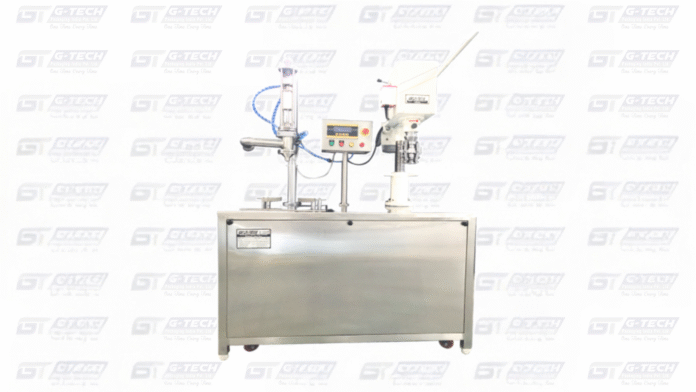
Walk along almost any automatic liquid packaging line and you will hear the hiss of air. Nozzles move up and down on pneumatic cylinders, bottle stoppers open and close, capping heads lift, label applicators push, and cartons are pressed shut. Compressed air is the hidden utility that drives much of this motion.
When air supply is poor, the symptoms often look like machine faults: nozzles that move slowly, inconsistent capping, valves that stick or a line that stops for no clear reason. This guide explains how to plan and maintain compressed air for packaging machines so that your line runs as designed.
Where Compressed Air Is Used on a Liquid Packaging Line
- Liquid filling machines: nozzle up-down movement, diving nozzles, bottle stoppers, piston cylinders on some volumetric machines
- Capping machines: cap pick-and-place, head lifting, cap chute gates and clamps
- Labeling machines: some label applicators and bottle separators
- Leak testing machines: pressurising or vacuum-related functions, depending on design
- Box sealing machines and pushers, diverters and rejection systems along the conveyor
Not every machine uses air for every function. Servo-driven designs replace some cylinders with motors. But most lines still rely on air somewhere, so the supply matters.
The Three Things Machines Need From Air
1. Correct and Stable Pressure
Each machine has a recommended working pressure in its manual. What matters on the shop floor is that the pressure at the machine stays stable while every machine on the line is running together. If pressure drops when several cylinders fire at once, movements slow down and timing goes out of step.
2. Enough Volume
Pressure is only half the story. The compressor must also deliver enough air volume for all machines running together, plus leakage and future additions. A compressor that reaches the right pressure in a quiet factory can still fall short when the full line runs.
3. Clean, Dry Air
Air from a compressor carries water vapour, oil traces and dust. Water condenses in pipes, rusts fittings and washes lubrication out of cylinders and valves. Where air may contact product or containers, such as in food, dairy or pharma lines, air quality needs even more attention and should follow your quality requirements.

The Basic Compressed Air System
| Component | Purpose | Common mistake |
|---|---|---|
| Compressor | Produces air at pressure | Sized only for today, not for line expansion |
| Receiver tank | Stores air and smooths pressure swings | Too small, or never drained |
| Air dryer | Removes moisture | Skipped to save cost |
| Filters | Remove particles and oil | Elements never replaced |
| Pipeline | Carries air to machines | Thin pipes, long runs, leaking joints |
| FRL unit at machine | Final filter, regulator and lubricator if required | Regulator set wrong or bowl full of water |
Planning Air When You Install a New Line
- List every pneumatic machine on the line and note the pressure and air consumption given by each supplier
- Add them together for simultaneous running and keep a margin for leaks and future machines
- Choose a compressor, receiver and dryer to match that total, not just the first machine
- Run a main pipe of adequate size close to the line, ideally as a loop so pressure stays even
- Take drops to machines from the top of the pipe so water does not run into machine connections
- Provide a drain point at low spots and at the end of lines
Air should be on your checklist alongside power and floor space when you plan a new line. Our bottle filling line layout guide covers how machines are arranged; the air main should follow that layout with easy access to every machine.
Air Problems That Look Like Machine Faults
- Nozzles or heads moving slowly: low pressure at the machine or an undersized supply line
- Water in the FRL bowl or spitting from exhausts: missing or faulty dryer, drains not working
- Sticky valves and cylinders: moisture, dirt or oil contamination
- Random stoppages when another machine starts: pressure dips due to shared, undersized supply
- Compressor running constantly: leaks in hoses, fittings or quick couplers
Simple Maintenance Routine
- Drain the receiver tank and filter bowls as per the compressor maker’s schedule, or fit auto-drains
- Check FRL pressure gauges at each machine at shift start
- Listen for leaks during a quiet period and fix them; small leaks add up
- Replace filter elements as recommended
- Service the compressor and dryer on schedule
Air checks fit naturally into the routine described in our preventive maintenance guide for liquid packaging lines.
Frequently Asked Questions
What air pressure do packaging machines need?
It varies by machine and design. Always follow the working pressure in each machine’s manual, and make sure the supply can hold that pressure at the machine while the whole line is running.
Do I really need an air dryer?
In most Indian factories, especially during the humid monsoon months, compressed air carries a lot of moisture. A dryer protects valves and cylinders from water and is strongly recommended for automatic packaging lines.
Can one compressor run the whole line?
Yes, if it is sized for the total air demand of all machines running together, with margin for leaks and expansion. Check the combined consumption before relying on one unit.
Talk to G-Tech Packaging About Your Line
G-Tech Packaging India Pvt. Ltd., Ahmedabad, designs and builds automatic filling, capping, induction sealing, labeling, leak testing, shrink tunnel and box sealing machines for Indian manufacturers. If you are planning a new line and want help listing its utility needs, including compressed air, share your container sizes, product details and target output with our team and we will suggest a practical machine configuration. Contact us here or write to sales@gtechpackaging.in.