“How many bottles per minute will this machine do?” is one of the first questions every buyer asks. The honest answer is that it depends on the liquid, the pack size, the number of heads and how the rest of the line performs. Knowing how to do a basic filling machine speed calculation helps you compare quotations properly and choose a machine that meets your real daily target.
This guide walks through the calculation step by step with a simple worked example. The figures in the example are only for illustration; your actual speeds should come from trials with your own product.
What Decides the Speed of a Filling Machine?
- Fill volume: a 5 litre can takes longer to fill than a 200 ml bottle.
- Liquid viscosity: thick oils, ghee and gels flow slower than water.
- Foaming: foamy liquids often need slower filling or nozzles that fill from the bottom up.
- Number of filling heads: more heads fill more bottles in each cycle.
- Indexing time: the time to move filled bottles out and empty ones in.
- Filling principle: volumetric piston, flow-meter or weighmetric filling each have different cycle times.
Step 1: Measure One Filling Cycle
On an inline machine, one cycle is the time to bring a set of bottles under the nozzles, fill them and move them out. Time several cycles with your product and take the average. On a rotary monoblock machine, filling happens continuously, so speed is usually stated directly in bottles per minute for a given pack.
Step 2: Calculate Theoretical Bottles Per Minute
For an inline machine, the formula is simple:
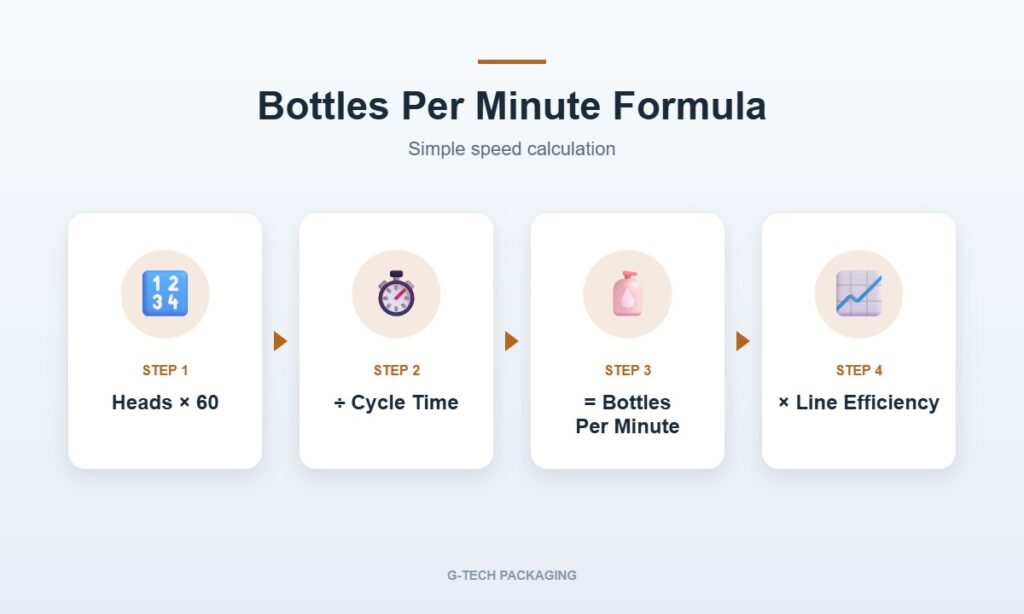
Bottles per minute = (Number of heads × 60) ÷ Cycle time in seconds
Example: an 8-head machine with a cycle time of 20 seconds gives (8 × 60) ÷ 20 = 24 bottles per minute. This is the theoretical speed if the machine never stops.
Step 3: Convert to Shift Output
Multiply bottles per minute by the minutes in a shift. Continuing the example, 24 bottles per minute over an 8-hour shift (480 minutes) gives 11,520 bottles in theory.
Step 4: Apply Real-World Efficiency
No line runs at 100 percent. Time is lost to changeovers, film or label roll changes, cap feeding issues, breaks, cleaning and small stoppages. Plants usually apply an efficiency factor based on their own experience. If, in our example, the line runs at 80 percent efficiency, the realistic output is 11,520 × 0.8 = 9,216 bottles per shift. Track your actual output for a few weeks to find your own figure.
| Step | Example calculation | Result |
|---|---|---|
| Theoretical speed | (8 heads × 60) ÷ 20 sec | 24 bottles/min |
| Theoretical shift output | 24 × 480 min | 11,520 bottles |
| Realistic output at 80% efficiency | 11,520 × 0.8 | 9,216 bottles |
| Required speed for 12,000 bottles/shift at 80% | 12,000 ÷ (480 × 0.8) | About 31 bottles/min |
Step 5: Work Backwards From Your Target
Buyers often know how many bottles they need per day. Work backwards: divide the daily target by available minutes and expected efficiency. That gives the speed the machine must deliver, which you can then use to decide how many heads you need. In the example table, a target of 12,000 bottles per shift at 80 percent efficiency needs about 31 bottles per minute, so an 8-head machine with a 20-second cycle would fall short.
The Line Is Only as Fast as Its Slowest Machine
A fast filler does not help if the capping machine, induction sealer or labeler cannot keep up. When planning a line, check the rated speed of every machine for the same pack size. Downstream machines are usually chosen with some extra speed so they do not hold back the filler. Also check conveyor length between machines, as some buffer space keeps small stoppages from stopping the whole line.
Common Mistakes in Speed Calculation
- Using speed for water when your product is a thick oil
- Comparing quotations made for different pack sizes
- Ignoring changeover time when you run many SKUs
- Planning on theoretical speed instead of realistic output
- Forgetting that the slowest machine sets the line speed
Once you know realistic output, you can also judge the payback of a new liquid filling machine. Our guide on calculating the real ROI of a liquid filling machine shows how to do that.
Planning for Multiple Pack Sizes
Most Indian plants fill more than one pack size on the same machine, for example 500 ml, 1 litre and 5 litre packs of the same oil. Each size has its own cycle time, so do the calculation separately for each one. Then estimate how many hours per week each size will run and add the changeover time between them. This gives a realistic weekly output and shows whether one machine is enough or whether a second line, or a machine with quicker changeover, makes more sense.
Frequently Asked Questions
How do I calculate bottles per minute for a filling machine?
Multiply the number of filling heads by 60 and divide by the cycle time in seconds. Then apply your line efficiency to get realistic output.
Why is actual output lower than the rated speed?
Rated speed assumes non-stop running with a specific product and pack. Changeovers, stoppages, breaks and slower downstream machines reduce real output.
Does liquid viscosity affect filling speed?
Yes. Thicker liquids flow more slowly, so cycle times are longer. Always ask for speed figures based on your actual product and pack size.
Talk to G-Tech Packaging India
G-Tech Packaging India Pvt. Ltd., Ahmedabad, designs and builds automatic filling, capping, induction sealing, labeling, leak testing, shrink tunnel and box sealing machines for Indian manufacturers. Share your product, pack sizes and daily target, and our team will suggest a filling line configuration that fits. Contact our team or email sales@gtechpackaging.in with your product, pack sizes and target output, and we will suggest a practical solution.