Buying a new filling or packaging machine is a big step for any factory. But the purchase is only half the job. How well the machine is installed and started up decides whether it runs smoothly for years or keeps giving trouble from the first week. Many problems blamed on the machine, such as uneven fills, frequent stoppages or electrical faults, actually come from poor site preparation or a rushed start-up.
This packaging machine installation checklist walks you through each stage, from preparing your site to final sign-off, so your new line starts producing good packs as early as possible.
Stage 1: Before the Machine Leaves the Supplier
Many buyers visit the supplier’s works for a Factory Acceptance Test (FAT). This is a trial run at the maker’s facility, ideally with your own containers, caps and product or a safe substitute such as water. It lets you catch issues before dispatch, when they are easiest to fix.
- Run the machine with every bottle and cap size you ordered.
- Check fill accuracy on a weighing scale over a reasonable number of containers.
- Confirm speed with your actual containers, not only the brochure figure.
- Inspect build quality, guards, wiring and labelling of parts.
- Agree in writing on any changes to be done before dispatch.
- Collect the list of change parts, spares and documents that will ship with the machine.
Stage 2: Preparing Your Site
Most installation delays happen because the site is not ready when the machine arrives. Use the layout drawing from your supplier and prepare in advance.
- Floor: level, strong enough for the machine weight, and easy to clean.
- Space: room for the machine, conveyors, operator movement, material storage and maintenance access on all sides.
- Electrical supply: correct voltage and phase, proper earthing, a dedicated isolator and cable routing as per the supplier’s requirement.
- Compressed air: if the machine uses pneumatics, arrange the required pressure with clean, dry air and a filter-regulator.
- Water and drainage: needed for cleaning, especially in food, dairy and chemical lines.
- Lighting and ventilation: good light at the filling and labeling zones, and fume extraction for chemical products.
- Unloading path: door width, ramp or forklift access to bring the machine in safely.
If you are setting up a full line rather than a single machine, our guide on bottle filling line layout explains how to arrange machines for smooth product flow.
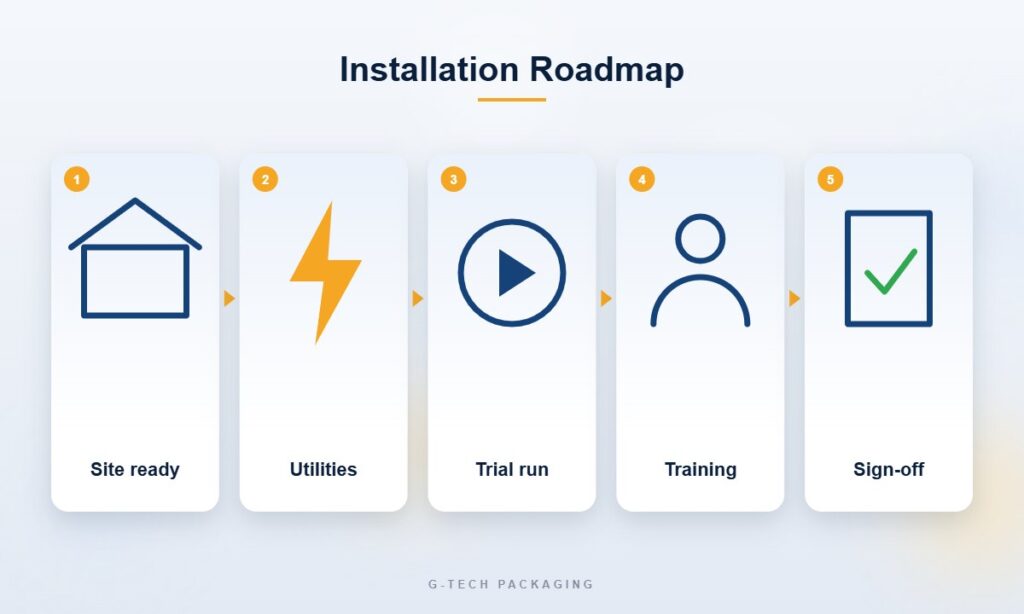
Stage 3: Installation Day
- Unpack carefully and check every crate against the packing list.
- Place machines as per the layout and level each one using the levelling feet.
- Align conveyors between machines so containers transfer smoothly without tipping.
- Connect power, air and water only through the agreed points, with the supplier’s technician present.
- Check the direction of motor rotation and test all emergency stop buttons before running.
- Make sure all guards and covers are fitted.
Stage 4: Commissioning and Trials
Commissioning means bringing the machine from installed to production-ready. Plan it in steps rather than jumping straight to full product runs. Many companies call the final trial at their own plant a Site Acceptance Test (SAT).
| Step | What to do | What to check |
|---|---|---|
| Dry run | Run without containers or product | Smooth movement, no unusual noise, sensors respond correctly |
| Water trial | Run with water in real containers | Fill levels, drips, conveyor transfer, capping on empty-safe settings |
| Product trial | Run with actual product at reduced speed | Fill accuracy, foaming, capping quality, labeling position |
| Full-speed run | Run at the target speed for a longer period | Stoppages, rejects, consistency across a shift |
| All sizes | Repeat for each container size | Changeover time and settings for each size |
Include quality checks downstream as well. A leak testing machine or a manual leak check during trials quickly shows whether filling and capping are set correctly. If you use secondary packaging, test the shrink tunnel or carton sealing with real packs.
Stage 5: Training Your Team
- Train at least two operators per shift, not just one key person.
- Cover start-up, shutdown, cleaning, size changeover and basic fault finding.
- Train maintenance staff on lubrication points, wear parts and safety interlocks.
- Ask operators to run the machine themselves while the technician watches, before the technician leaves.
- Prepare a simple one-page start-up and changeover sheet in the local language and display it near the machine.
Stage 6: Documents and Sign-Off
- Operation and maintenance manual.
- Electrical and pneumatic drawings.
- List of spare parts with part numbers.
- Recorded settings for each container size.
- Warranty terms and service contact details.
- A signed installation and commissioning report listing any pending points and their target dates.
After sign-off, set up a regular service routine from day one. Our article on the preventive maintenance routine for a liquid packaging line is a good next read. You can also browse our full range of liquid filling machines.
Frequently Asked Questions
What is the difference between FAT and SAT?
A Factory Acceptance Test (FAT) is done at the supplier’s works before dispatch. A Site Acceptance Test (SAT) is done at your plant after installation, with your utilities, product and operators.
How long does installation and commissioning take?
It depends on the machine, the number of sizes and how ready your site is. A single machine on a prepared site can be quick, while a full line takes longer. Ask your supplier for a plan based on your order.
Who should be present during commissioning?
The supplier’s technician, your production head, at least two operators, a maintenance person and someone from quality control should be present, so every team understands the machine from the start.
Talk to G-Tech Packaging About Your New Packaging Line
G-Tech Packaging India Pvt. Ltd., Ahmedabad, designs and builds automatic liquid filling, capping, induction sealing, labeling, leak testing, shrink tunnel and box sealing machines for Indian manufacturers. Share your product, container samples and target output with our team, and we will suggest a practical machine or full line for your plant.
Contact us here or write to sales@gtechpackaging.in to discuss your requirement.