An induction sealing machine is one of the simplest machines on a liquid packaging line, yet it causes a surprising number of complaints when it is not set up correctly. A bottle that leaves the line with a weak, burnt or half-bonded foil can leak in transit, fail a tamper check or come back as a customer complaint. The good news is that most induction sealing problems have a small number of root causes, and almost all of them can be fixed by the line team.
This guide explains how induction sealing works, the four most common faults, what causes each one and the checks your operators can run at the start of every shift.
How an Induction Sealing Machine Works
The cap arrives on the conveyor with an induction liner inside it. This liner is usually a laminate of aluminium foil and a heat-seal polymer layer, sometimes backed by a pulpboard and wax layer in two-piece liners. As the capped container passes under the sealing head, a high-frequency coil creates an electromagnetic field. This field induces eddy currents in the aluminium foil, the foil heats up and melts the polymer layer, and the polymer bonds to the lip of the container. The cap itself is not heated directly.
Because the process depends on heat, contact pressure and time, the seal quality is controlled by a few settings: power output, conveyor speed, the gap between the head and the cap, and the cap application torque. When one of these drifts, you see a fault.
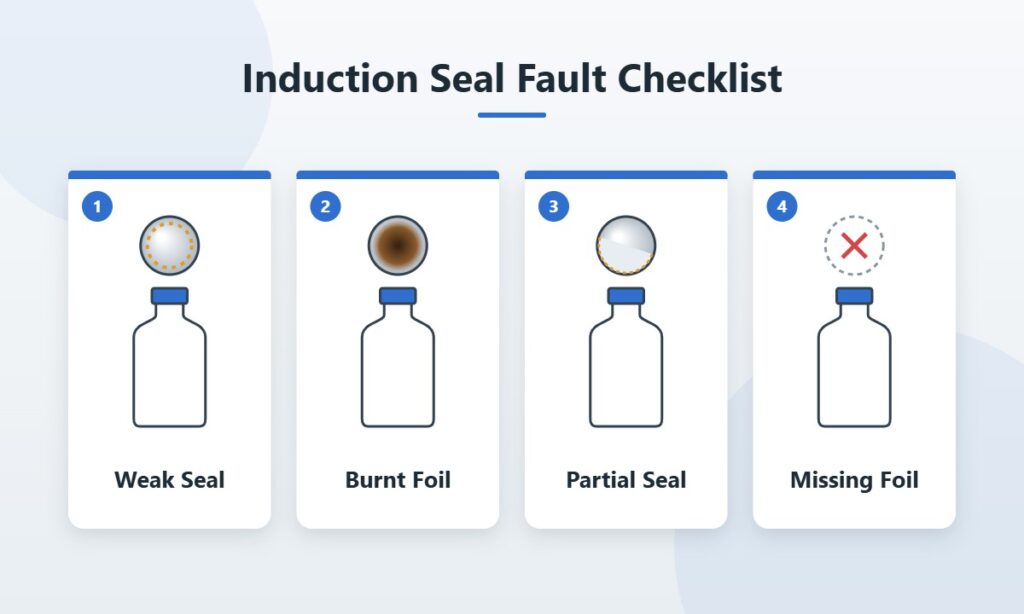
The Four Most Common Induction Sealing Problems
1. Weak seal or foil that peels off too easily
A weak seal is usually caused by too little heat reaching the foil. Common reasons are low power, a conveyor running too fast for the power setting, or a sealing head set too high above the caps. Low cap torque is another frequent cause, because the liner is not pressed firmly against the container lip while the polymer melts. Product on the lip, such as oil, ghee or chemical residue, also stops the polymer from bonding properly.
2. Burnt, blackened or wrinkled foil
This is the opposite problem: too much energy. It happens when power is set too high, the conveyor is too slow, the head is too close to the caps, or a container stops under the head when the line halts. Very high torque can also squeeze and wrinkle the liner. Overheating can damage the container neck and in some cases distort the cap.
3. Partial seal on one side
A seal that bonds on one side but not the other usually points to an alignment issue. A tilted cap, an uneven container lip, a head that is not parallel to the conveyor, or bottles running off-centre under the coil will all heat the foil unevenly. Tall or sports-type caps sometimes need a tunnel-type coil instead of a flat coil to heat the foil evenly.
4. Missing foil
Sometimes the bottle passes the sealer but there is no liner in the cap at all. This is a cap supply problem, not a sealer problem. Liners can fall out during cap transport or storage, or a batch of caps may arrive without liners. Many lines add a foil detection and reject system after the sealer so that unsealed containers are removed automatically.
Quick Troubleshooting Table
| Problem | Likely causes | What to check first |
|---|---|---|
| Weak seal | Low power, high speed, large head gap, low torque, wet lip | Power and speed settings, head height, capping torque |
| Burnt or wrinkled foil | High power, slow speed, head too low, line stoppage | Power setting, conveyor speed, stop interlock |
| Partial seal | Tilted cap, uneven lip, head not level, wrong coil type | Cap alignment, guide rails, head levelling |
| Missing foil | Liners falling out of caps, wrong cap batch | Cap inspection, foil detection and reject unit |
Notice how often cap torque appears in the table. Induction sealing and capping work as a pair, so a stable automatic capping machine is just as important as the sealer itself.
Matching the Liner to Your Container
The heat-seal layer of the liner must be compatible with the container material. A liner designed for HDPE will not necessarily bond to PET or glass. If a new container or cap supplier has been introduced and seals suddenly fail even with correct settings, ask your cap supplier to confirm that the liner suits your bottle material and your product. Oils, solvents and agro-chemicals can attack some liner layers, so product compatibility matters too.
Daily Checks for Operators
- Confirm the power, speed and head height match the recipe for the container being run.
- Check that the sealing head is level and centred over the conveyor.
- Verify cap torque on a few samples before production starts.
- Keep the container lip clean; adjust filling nozzles if product is splashing onto the neck.
- After sealing, remove a few caps and inspect the foil for full, even bonding all around the lip.
- Run sample containers through a leak test, especially after any change in settings.
For a deeper look at the sealing step itself, explore G-Tech’s online induction sealing machines and pair them with a leak testing machine for final checks. You can also read our earlier article on why induction cap sealing matters for leak-proof packaging.
When to Call for Service
If the settings are correct, the caps and liners are right, and faults still appear, the cause may be electrical: a failing coil, cooling problems in the head or a power supply that is not delivering stable output. These checks are best left to a trained technician. Edible oil, ghee and pesticide packers in particular should treat repeated seal failures as urgent, because leaks in these products cause losses and safety concerns.
Frequently Asked Questions
Why does my induction seal peel off easily?
Usually because too little heat reached the foil or the liner was not pressed firmly against the lip. Check power, conveyor speed, head height and cap torque, and make sure the container lip is clean and dry.
Can induction sealing work on glass bottles?
Yes, provided the liner has a heat-seal layer designed for glass. The liner must always match the container material.
How do I test an induction seal on the line?
Remove the cap from sample containers and inspect the foil for complete, even bonding. Many plants also run samples through a leak tester or perform a simple squeeze or inversion test as a routine check.
Talk to G-Tech Packaging India
Want a reliable sealing step on your line? G-Tech Packaging India Pvt. Ltd., Ahmedabad, designs and builds liquid filling, capping, induction sealing, labeling, leak testing, shrink tunnel and box sealing machines for Indian manufacturers. Share your container, product and output target with our team through the Contact Us page or email sales@gtechpackaging.in, and we will suggest a practical machine setup for your line.