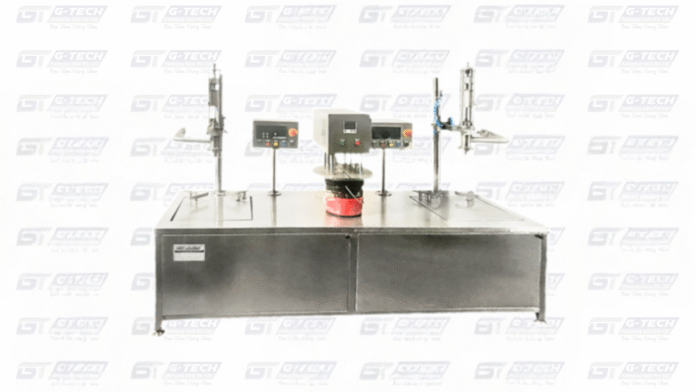
When factory owners start looking at automatic liquid filling, one of the first options they come across is the gravity filling machine. It is simple, easy to clean and well suited to thin, free-flowing liquids. But it is not the right answer for every product. Edible oils, lubricants and thicker liquids are usually better served by volumetric or weight-based filling.
This guide explains how a gravity filler works, where it performs well, where it struggles, and how it compares with volumetric filling, so you can choose the right machine for your product and containers.
What Is a Gravity Filling Machine?
A gravity filling machine uses the natural flow of liquid from a tank placed above the filling nozzles. When a valve opens, liquid flows down into the container. Filling is controlled either by time (the valve stays open for a set period) or by level (filling stops when the liquid reaches a set height in the container). It belongs to the wider family of liquid filling machines used across Indian industry.
How Gravity Filling Works
- Liquid is stored in an overhead tank, often with a float or level control to keep the head steady.
- Bottles move under the nozzles on a conveyor and are stopped in position.
- Nozzles open and liquid flows into the bottles.
- Filling stops on a timer or when the set level is reached.
- Bottles move on to capping, sealing and labeling.
Because the flow depends on gravity, the height of liquid in the tank, the liquid temperature and its thickness all affect how fast it flows. That is why gravity fillers suit liquids whose flow behaviour stays consistent.
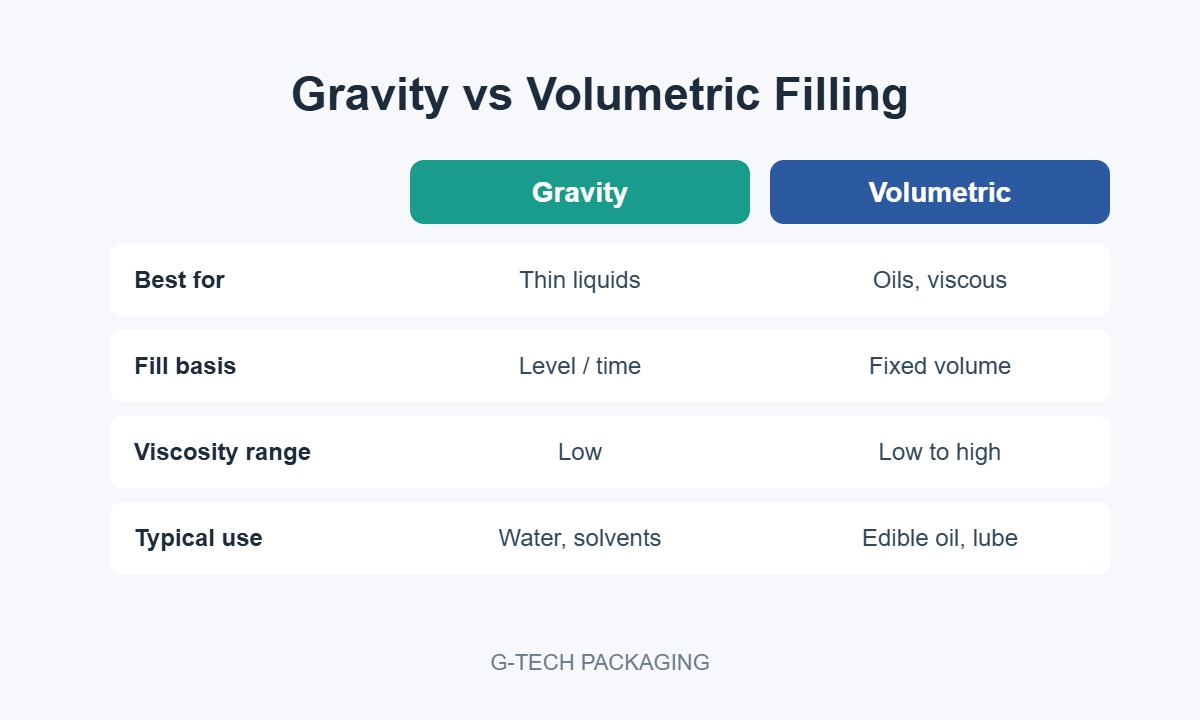
Gravity vs Volumetric Filling Machine
| Point | Gravity filling | Volumetric filling |
|---|---|---|
| Filling principle | Liquid flows by gravity, controlled by time or level | A fixed volume is measured and dispensed for each container |
| Best liquids | Thin, free-flowing liquids | Thin to viscous liquids, including oils |
| Effect of viscosity changes | Flow rate changes with temperature and thickness | Measured volume is less affected |
| Typical products | Water, some solvents, thin chemicals | Edible oil, lubricants, syrups, many chemicals |
| Cleaning | Simple flow path | Depends on pump or piston design |
If you fill oils, a volumetric oil filling machine is usually the more dependable choice, because oil thickness changes with temperature across Indian seasons. We compare volumetric and weight-based filling in detail in our article on volumetric vs weighmetric oil filling machines.
Where Gravity Filling Makes Sense
- Packaged water and thin beverages: water flows consistently and level filling gives an even look on the shelf.
- Thin chemicals and solvents: where the liquid is compatible with the machine materials.
- Products where visual fill level matters more than exact volume, in transparent bottles.
- Lower budget starter lines for thin liquids where simplicity is valued.
Where Gravity Filling Struggles
- Viscous liquids such as edible oil in winter, lubricants and gels flow too slowly and unevenly.
- Products sold by exact net quantity need careful setting, because time-based gravity filling can drift if tank level or temperature changes.
- Foaming liquids may need special nozzles or slower filling.
- Containers with uneven wall thickness can show different levels even with the same volume.
How to Choose Between Gravity and Volumetric
Know your liquid
Test how your product flows at different temperatures. If its thickness changes noticeably, a volumetric or weight-based system will give more consistent results.
Know your declaration
If you declare net volume or weight on the label, your filling method must deliver that quantity consistently. Discuss with your machine maker which method best meets your declared quantity for your product.
Think about future products
A plant that fills only water today may add a thicker product later. Choosing a flexible filling system can save a second machine purchase.
Setup and Maintenance Tips for Gravity Fillers
- Keep the overhead tank level steady using the level control.
- Clean nozzles and valves regularly to prevent dripping and uneven flow.
- Check fill levels at the start of every shift and after any product change.
- Inspect seals and gaskets for wear, especially with chemicals.
- Record timer or level settings for each bottle size for quick changeovers.
Questions to Ask Your Machine Maker
Before you finalise any filling machine, a short list of questions saves a lot of trouble after installation. Ask the supplier to fill a trial with your actual product and bottles, and check the results across several containers rather than one. Ask how the machine handles a change in liquid temperature, how fill quantity is adjusted, how long a bottle size changeover takes, and which parts touch the product. Also ask what happens when you add a new bottle size later, and whether the filler can be connected to capping, sealing and labeling machines on the same conveyor. Clear answers to these points will tell you whether gravity or volumetric filling is right for your plant.
Frequently Asked Questions
Is a gravity filling machine suitable for edible oil?
It is generally not the first choice, because oil thickness changes with temperature, which affects gravity flow. Volumetric or weight-based oil filling machines are usually preferred.
What is the difference between time-based and level-based gravity filling?
Time-based filling keeps the valve open for a set time, while level-based filling stops when the liquid reaches a set height in the container. Level filling gives a uniform look in clear bottles.
Can a gravity filler be automated with capping and labeling?
Yes. Like other filling machines, it can be connected by conveyor to capping, induction sealing and labeling machines to form a complete line.
Talk to G-Tech Packaging India About Your Line
G-Tech Packaging India Pvt. Ltd., Ahmedabad, designs and builds automatic liquid filling, capping, induction sealing, labeling, leak testing, shrink tunnel and box sealing machines for Indian manufacturers. If you are planning a filling line and want to decide between gravity and volumetric filling, share your container sizes, product details and target output with our team and we will suggest a practical setup. Contact us here or email sales@gtechpackaging.in.