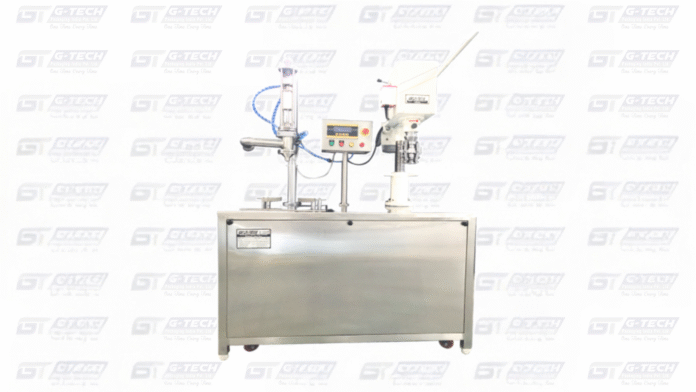
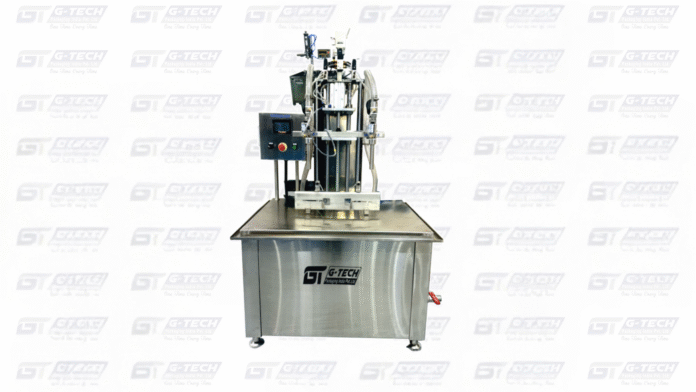
Trigger sprayers and pump dispensers are among the hardest closures to apply automatically. Unlike a simple round screw cap, a trigger head is not symmetrical, has a dip tube hanging below it, and must end up facing the right direction on the bottle. Many factories still cap these bottles by hand for that reason – and pay for it in slow output, uneven torque and leaking packs.
This guide explains how a trigger spray capping machine works, the main types available, and what to check when you plan to automate trigger or pump capping on your line. You can also explore our full range of capping machines.
Why Trigger and Pump Caps Are Different
- Odd shape: the trigger head sticks out on one side, so the machine cannot grip it like a round cap.
- Dip tube: the tube must enter the bottle neck cleanly before the cap is screwed on.
- Orientation: customers expect all triggers on a shelf to face the same way, so the final position matters.
- Fragile parts: too much torque or pressure can crack the trigger body or damage the pump mechanism.
A machine built for these closures handles each of these points with dedicated tooling rather than forcing a standard capper to do the job.
How a Trigger Spray Capping Machine Works
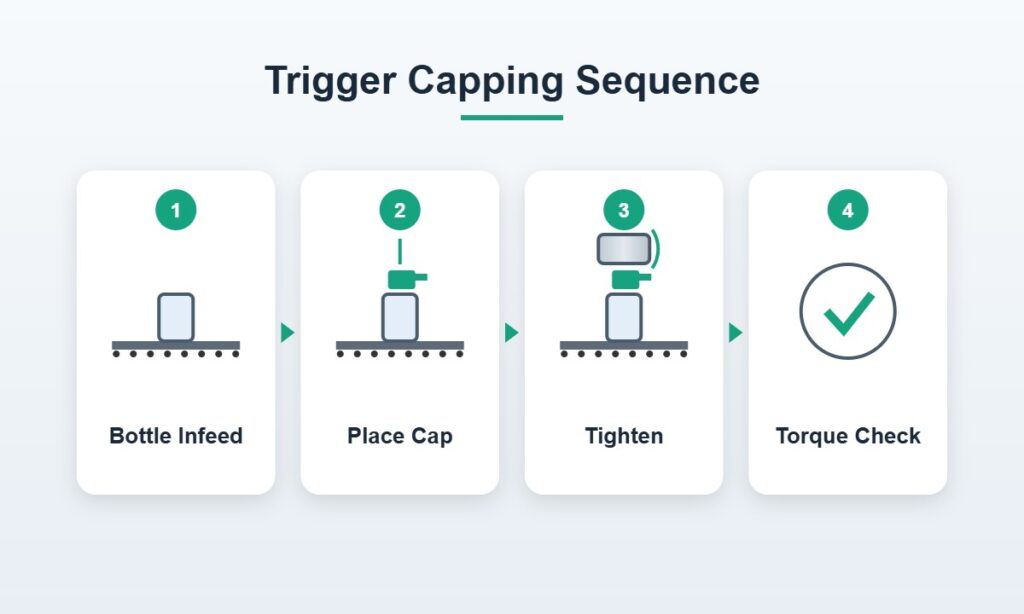
Designs vary, but most automatic and semi-automatic machines follow the same basic sequence:
- Bottle infeed: bottles arrive on the conveyor and are spaced and held in position by a star wheel, gripper belts or a stopper.
- Cap placement: the trigger or pump cap is placed on the bottle neck with the dip tube inserted. On many lines this is done manually by an operator; higher-speed lines use a pick-and-place unit.
- Alignment: guides or a shaped chuck hold the trigger head so it does not swing while tightening.
- Tightening: a capping chuck or spindle screws the cap down to a set torque using a clutch or servo control. Snap-on closures are pressed on instead of screwed.
- Discharge: capped bottles move on to labeling, sealing or packing.
Main Machine Types Compared
| Type | Cap placement | Tightening | Suits |
|---|---|---|---|
| Semi-automatic capper | Operator places cap | Machine tightens to set torque | Small batches, many SKUs |
| Automatic inline capper | Operator or simple placer | Chuck or spindle on conveyor | Medium output lines |
| Pick-and-place capper | Automatic placement | Chuck with torque control | Higher output, steady SKUs |
Many growing manufacturers start with a semi-automatic or inline machine where an operator places the trigger and the machine handles tightening. This alone gives consistent torque and removes the strain of hand-tightening hundreds of caps an hour. Pick-and-place automation can be added later when volumes justify it.
Where Trigger and Pump Capping Is Used
Trigger sprayers and pump caps are common on household cleaners, surface sanitisers, garden and crop sprays, hair and skin care products, and liquid hand wash. That makes this machine relevant to personal care, chemical and agro-chemical manufacturers. In each case the product is only the context – the challenge for the machine is the closure.
What to Check Before You Buy
- Cap samples: share actual trigger and pump caps, including dip tube lengths, with the machine maker.
- Bottle shapes: round, oval and flat bottles need different holding methods.
- Torque range: the machine should apply the torque your closure supplier recommends, and repeat it consistently.
- Changeover: ask how long it takes to switch between caps and bottles, and which parts change.
- Integration: check how the capper connects to your filling machine, induction sealer and labeler.
- Output target: base the machine choice on realistic bottles per minute for your packs, not the top number in a brochure.
Getting Torque Right
Trigger caps that are too loose leak during transport; caps that are too tight crack or become hard for the customer to open. Use a torque meter to check samples at the start of each shift and after any change. If you are already seeing loose or over-tight caps, our article on fixing cap torque problems on your capping line explains the common causes.
Maintenance Basics
Keep chucks, gripper pads and guides clean, because product spills can make caps slip. Check clutch settings regularly, replace worn gripper pads in time, and inspect the dip tube guide so tubes do not bend or kink during placement.
Planning the Capping Station on Your Line
Where the capper sits matters as much as the machine itself. Place it right after the filling machine so open bottles do not travel far, and leave enough space for an operator if caps are placed by hand. Keep a small buffer of caps within easy reach, and give the operator good lighting and a comfortable working height. If the bottles then go through induction sealing or labeling, make sure conveyor speeds match so bottles do not pile up or tip over between machines.
Frequently Asked Questions
Can a normal screw capping machine apply trigger caps?
Usually not well. Standard cappers grip round caps, while trigger heads are irregular and need guides or shaped chucks to hold them and control their final position.
Can the same machine handle pump caps and trigger sprayers?
Often yes, with change parts. The bottle holding, chuck and guides are changed for each closure type. Confirm this with samples before ordering.
Is cap placement automatic on all trigger spray capping machines?
No. Many machines use manual placement with automatic tightening. Fully automatic placement is available but adds cost and is best for lines with steady, high volumes.
Talk to G-Tech Packaging India
Want to automate trigger or pump capping on your line? Send us your cap and bottle samples. G-Tech Packaging India Pvt. Ltd., Ahmedabad, designs and builds automatic filling, capping, induction sealing, labeling, leak testing, shrink tunnel and box sealing machines for Indian manufacturers. Share your container, cap and output details through our contact page or write to sales@gtechpackaging.in, and our team will suggest a practical setup for your line.